> For the complete documentation index, see [llms.txt](https://doc.batch.com/llms.txt). Markdown versions of documentation pages are available by appending `.md` to page URLs; this page is available as [Markdown](https://doc.batch.com/guides-and-best-practices/profiles/how-to-import-an-audience-to-target-specific-users.md).
# How to import an audience to target specific users?
Let's take a look at how to target specific users with an audience.
Importing an audience allows you to target specific users to test an orchestration in real conditions, to test your dynamic content, or to simply target static segments exported from your userbase (e.g. top 500 buyers) or created by third-party tools.
There are two types of audiences: **normal audiences** or **rich audiences**. Let's take a look at both!
### 1. Audiences
An [audience](https://doc.batch.com/getting-started/features/customer-engagement-platform/profiles/audiences) allows you to upload a static list of users, which you can then target in your orchestration. To use an audience, follow the steps below.
#### Add a new audience
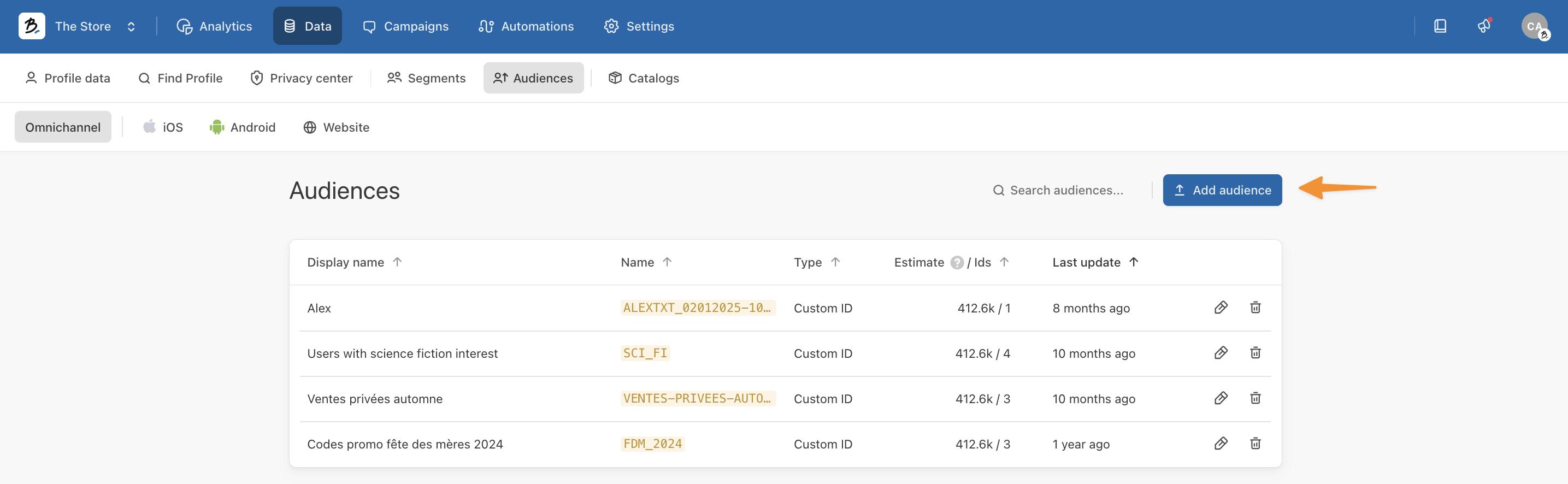
To create a new audience, go to **Data** > **Audiences** and click on **Add audience**. Choose an **Audience type**:
* Customer User IDs
* Emails
* Install IDs
#### Upload the audience file
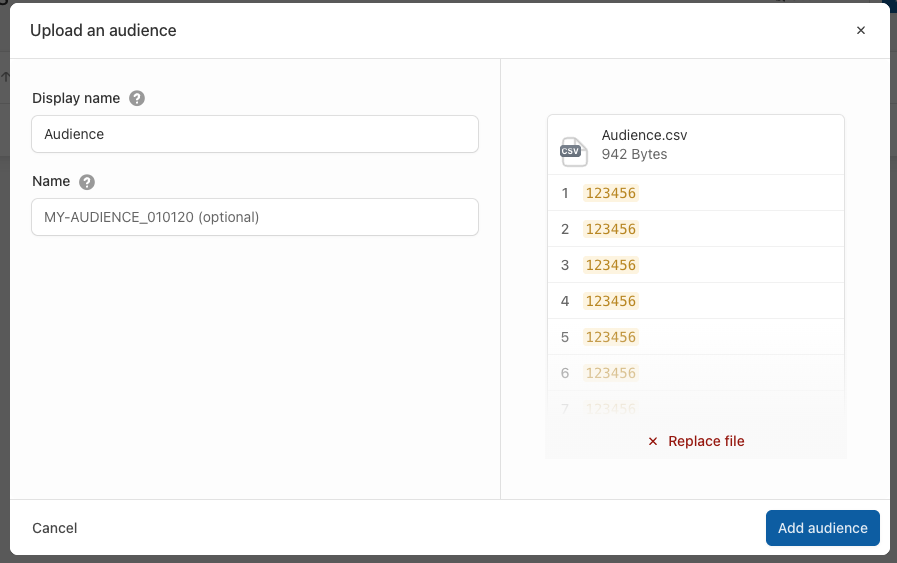
Upload a **.txt** or **.csv** file (**50 MB maximum**), with **one ID per line**, matching the Audience type you selected above:
#### Use the audience in your orchestration
Once the audience is uploaded, create your orchestration and use the audience in your targeting.
{% hint style="warning" %}
You can also upload your audience to the dashboard through the [Audience API](https://doc.batch.com/developer/api/cep/audiences/create).
{% endhint %}
### 2. Rich audiences
A **rich audience** is a static list of users, which you can associate to one or several attributes. You can then call these attributes in your orchestration for personalization purposes.
#### Rich audience file
The rich audience file should contain the IDs matching your chosen Audience type (Customer User IDs, Emails, or Install IDs) and the associated attributes, each in one column.
* For rich audiences uploaded manually on the dashboard, up to 10 associated string attributes are allowed in the CSV file.
* For rich audiences uploaded through our [Audience API](https://doc.batch.com/developer/api/cep/audiences/create), several attributes with different formats can be included.
#### Personalization
To [personalize](https://doc.batch.com/getting-started/features/customer-engagement-platform/message/personalization#audience-data) your orchestration with the values in your rich audience, first add the audience to the targeting.
In the title/body of your message, use the following code to call the attributes:
* For rich audiences uploaded manually on the dashboard, call **one attribute per expression**, using the auto-generated attribute name (`att1`, `att2`, etc.):
```
`{{audienceAttribute('audience_code', 'att1')}}`
```
Repeat the expression for each additional attribute, e.g. `{{audienceAttribute('audience_code', 'att2')}}`.
{% hint style="danger" %}
The **att1/2/3...** value should be added as such in the code and should not be changed.
{% endhint %}
* For rich audiences uploaded through the Audience API:
`{{audienceAttribute(, )}}`
---
# Agent Instructions
This documentation is published with GitBook. GitBook is the documentation platform designed so that both humans and AI agents can read, navigate, and reason over technical content effectively. Learn more at gitbook.com.
## Querying This Documentation
If you need additional information that is not directly available in this page, you can query the documentation by asking a question.
Perform an HTTP GET request on the following URL with the `ask` and `goal` query parameters:
```
GET https://doc.batch.com/guides-and-best-practices/profiles/how-to-import-an-audience-to-target-specific-users.md?ask=&goal=
```
`ask` is the immediate question: it should be specific, self-contained, and written in natural language.
`goal` is what the user is ultimately trying to achieve, the reason they need the answer. Sharing it helps GitBook give you a better, more relevant answer. A goal is most helpful when it describes the outcome the user wants rather than restating the question. For example, with `ask=how do I create an API token`, a goal like `automate deployments from our CI pipeline` lets GitBook tailor the answer to that use case.
The response will contain a direct answer to the question and relevant excerpts and sources from the documentation.
Use this mechanism when the answer is not explicitly present in the current page, you need clarification or additional context, or you want to retrieve related documentation sections.