> For the complete documentation index, see [llms.txt](https://doc.batch.com/llms.txt). Markdown versions of documentation pages are available by appending `.md` to page URLs; this page is available as [Markdown](https://doc.batch.com/guides-and-best-practices/message/email/content-and-media/how-to-add-a-pre-header-to-an-email-template.md).
# How to add a pre-header to an email template?
The pre-header serves as a powerful tool to enhance the effectiveness of your email campaigns, learn how to add it to your email template!
Email marketing is a powerful tool for engaging with your audience, but optimizing your campaigns for maximum impact requires attention to detail!
One crucial element often overlooked is the pre-header, a valuable asset that can significantly improve the open rate of your email campaigns.
### Understanding the pre-header
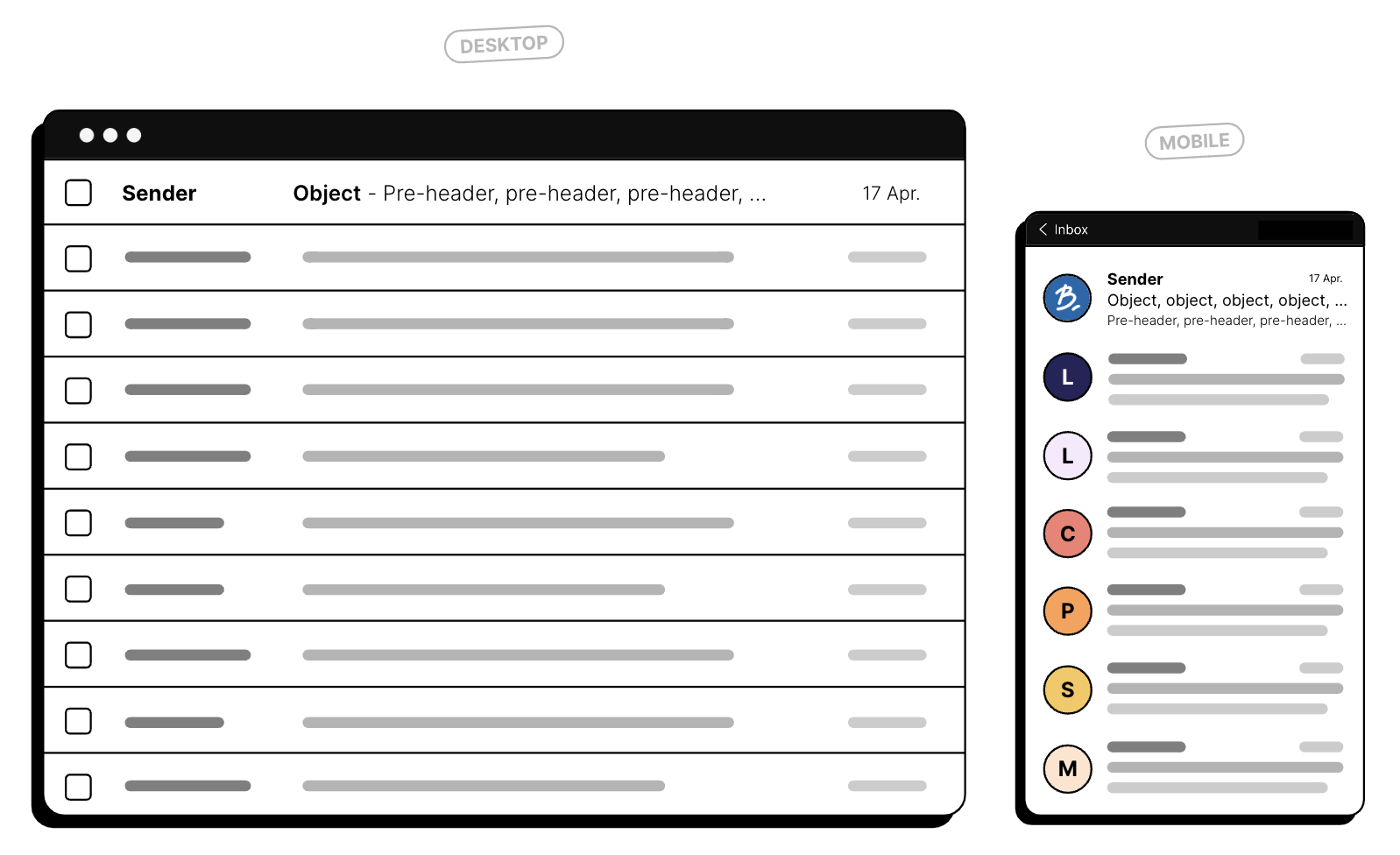
The pre-header is the snippet of text that follows the subject line in an email inbox:
By default, the first lines of an email are often displayed as a preview. However, these lines may not always provide valuable information to entice recipients to open the email.
{% hint style="success" %}
Generic greetings such as *'Dear customer, we are pleased to...'* might not be compelling and a well-crafted pre-header can make a substantial difference 💪
{% endhint %}
### How to add a pre-header to your email template
To take control of your email pre-headers, you can effortlessly add a pre-header directly within your template in the Message settings tab.
Most email clients display the beginning of the email body right after the subject and pre-header in the inbox preview. To avoid showing this content, you can enable the **Fill in with white space** option. This adds empty space after the subject and pre-header, preventing any text from the email body from appearing.
When the **Fill in with white space** option is enabled, inbox previews will show empty space after the pre-header.
By incorporating this step, you can customize your pre-header text, providing a concise and compelling summary that encourages recipients to open and engage with your emails.
---
# Agent Instructions
This documentation is published with GitBook. GitBook is the documentation platform designed so that both humans and AI agents can read, navigate, and reason over technical content effectively. Learn more at gitbook.com.
## Querying This Documentation
If you need additional information that is not directly available in this page, you can query the documentation by asking a question.
Perform an HTTP GET request on the following URL with the `ask` and `goal` query parameters:
```
GET https://doc.batch.com/guides-and-best-practices/message/email/content-and-media/how-to-add-a-pre-header-to-an-email-template.md?ask=&goal=
```
`ask` is the immediate question: it should be specific, self-contained, and written in natural language.
`goal` is what the user is ultimately trying to achieve, the reason they need the answer. Sharing it helps GitBook give you a better, more relevant answer. A goal is most helpful when it describes the outcome the user wants rather than restating the question. For example, with `ask=how do I create an API token`, a goal like `automate deployments from our CI pipeline` lets GitBook tailor the answer to that use case.
The response will contain a direct answer to the question and relevant excerpts and sources from the documentation.
Use this mechanism when the answer is not explicitly present in the current page, you need clarification or additional context, or you want to retrieve related documentation sections.