> For the complete documentation index, see [llms.txt](https://doc.batch.com/llms.txt). Markdown versions of documentation pages are available by appending `.md` to page URLs; this page is available as [Markdown](https://doc.batch.com/guides-and-best-practices/email-deliverability/email-authentication-and-sending-structure/sending-ip-configuration-and-selection.md).
# Sending IP Configuration and Selection
Overview of sending IP configurations, including shared and dedicated IPs, and their impact on sender reputation and deliverability.
## Understanding Sending IPs
A **sending IP** is the **machine from which your emails are dispatched** to inbox providers such as Gmail or Outlook. Every sending machine has a unique IP address that identifies it on the internet. When you send campaigns through Batch, your messages are routed through a **sending infrastructure** that connects your **domain** to inbox providers using this **IP address**.
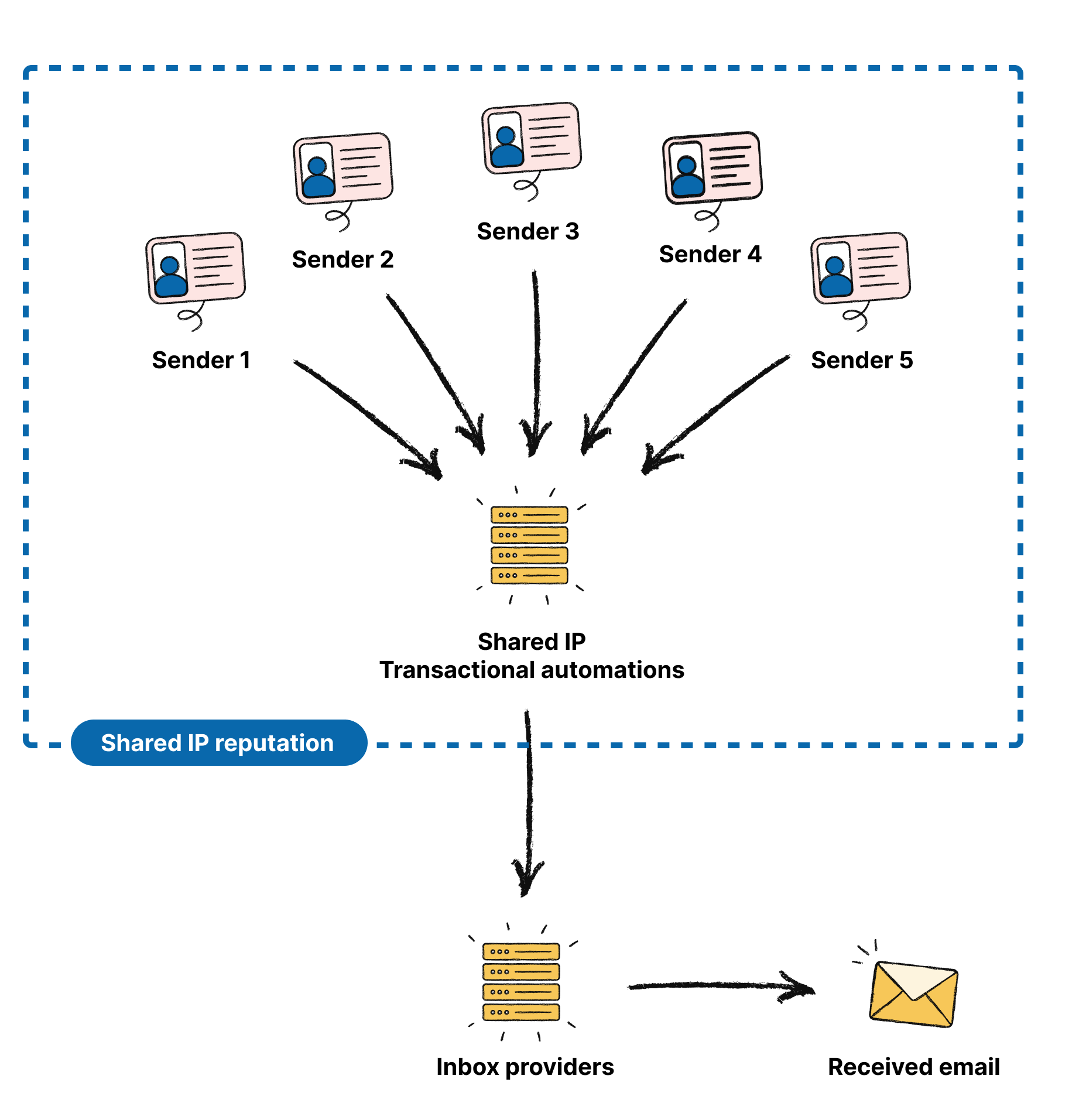
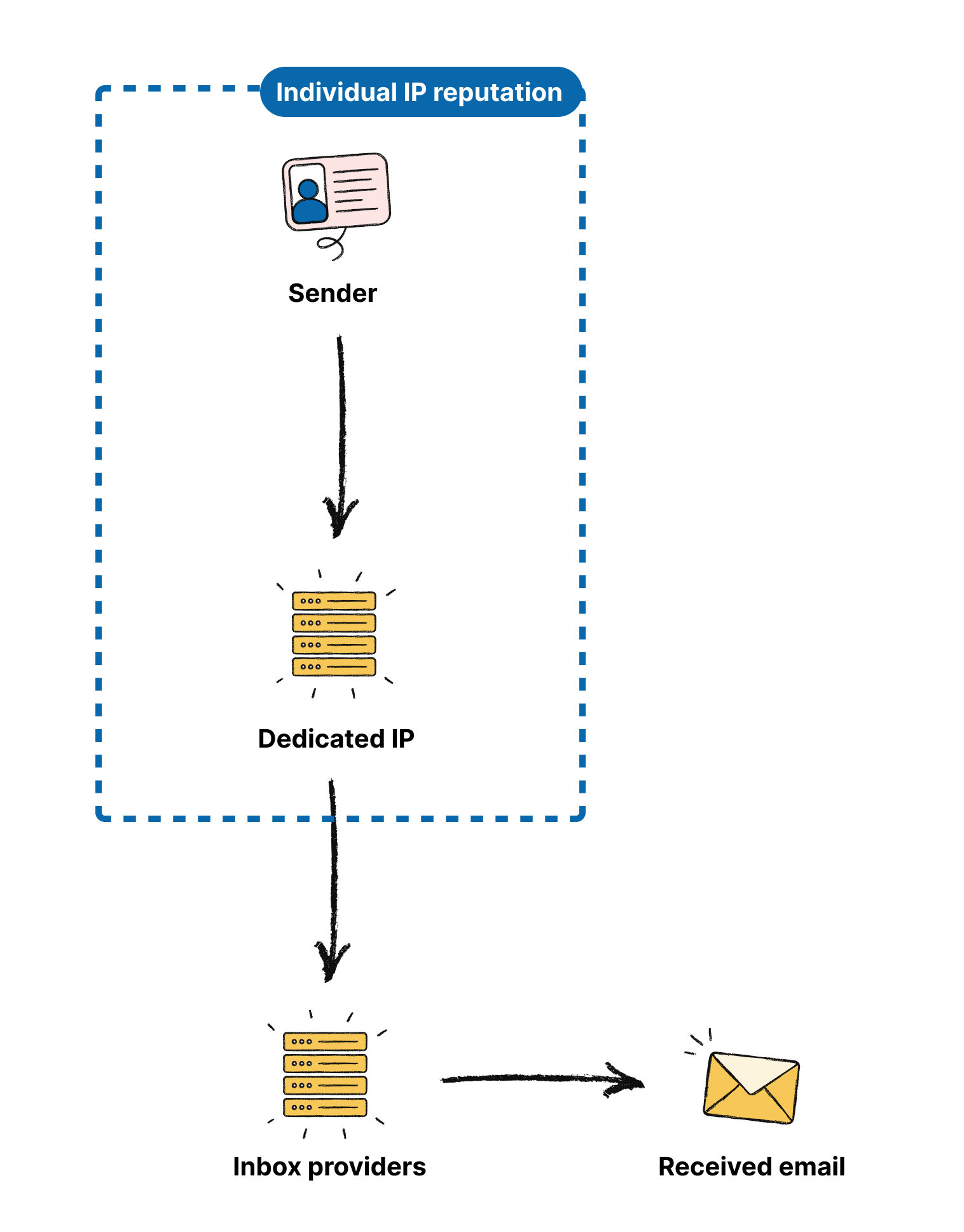
**Inbox providers** continuously evaluate senders to protect recipients from **spam and unwanted messages**. To do so, they rely on reputation scoring systems built on multiple parameters, which may vary from one provider to another. **Reputation** is typically associated with a combination of your **sending domain** (e.g., [hello.domain.com](http://hello.domain.com) and its root domain) and the **sending IP**.
This reputation takes into account factors such as email authentication, sending volume and frequency, historical performance, content quality, and recipient engagement, and other relevant signals. Maintaining a strong reputation across both your domain and sending IP is essential to ensure **optimal deliverability**.
## Shared vs. Dedicated IPs
### → IP Setup Options
#### Shared IP
A shared IP is recommended for small to mid-sized senders with moderate or irregular volumes. Your emails are sent from your own domain through an IP also used by other Batch customers. Because shared IPs are pre-warmed, they benefit from an existing sending history, making onboarding easier and reducing the risk of early deliverability issues. However, reputation is shared, meaning your performance can be influenced by the practices of other senders.
#### Dedicated IP
A dedicated IP is designed for high-volume senders with consistent sending patterns. It is exclusively assigned to your account, giving you full control over reputation and performance. However, it starts without any history and requires a structured warm-up, as well as sufficient and regular volume to maintain strong deliverability over time.
### → Qualification Criteria
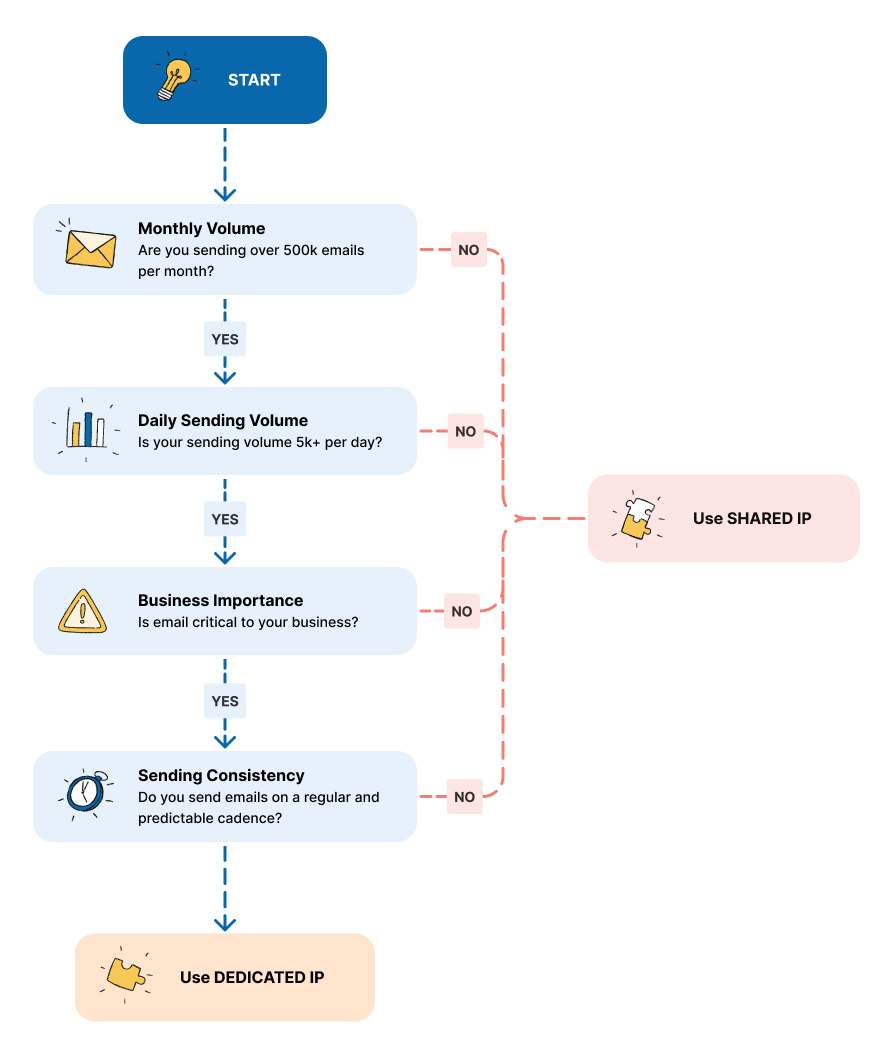
When sending email at scale, the choice between a dedicated IP and a shared IP can significantly impact deliverability. The decision depends on your sending volume, business type, and email performance indicators.
### Key Criteria for Choosing Between Dedicated and Shared IPs
#### 1. Sending Volume
* High Volume: Dedicated IPs are ideal for businesses sending thousands of emails per day. This allows consistent reputation building.
* Low to Medium Volume: Shared IPs are suitable for smaller volumes. The shared reputation of other senders can help maintain inbox placement.
#### 2. Email Performance Indicators
* Poor deliverability metrics (high bounce rates, spam complaints) may benefit from a dedicated IP to isolate and manage reputation.
* Strong positive metrics can continue on shared IPs without impacting performance.
#### 3. Type of Business
* Enterprise-Level Companies: Businesses that rely heavily on email for revenue, such as e-commerce or financial services, may require a dedicated IP to control reputation.
* Smaller Businesses: Companies with irregular sending patterns can leverage shared IPs to benefit from established reputation.
#### 4. Sending Regularity
* Consistent sending schedules favor dedicated IPs, as reputation is gradually built.
* Sporadic or seasonal sending is better suited for shared IPs, as the shared reputation reduces the impact of inactivity.
### → Summary Table
| **Qualification Criteria** | **Dedicated IP** | **Shared IP** |
| -------------------------- | ---------------------------------------------------------------------- | ------------------------------------------ |
| **Sending Volume** | 5-10k emails/day per IP consistently | Irregular or low daily volume |
| **Performance Indicators** | Full control (your reputation only) | Shared reputation across multiple senders |
| **Business Type** | Enterprise-level companies Revenue-critical email flows (e.g. fintech) | SMBs, startups, early-stage email programs |
| **Sending Pattern** | Regular, predictable sending cadence | Less regular campaign-based sending |
## Final Recommendation
* Use **dedicated IPs** for high-volume, enterprise-level email programs requiring strict reputation control.
* Use **shared IPs** for smaller, less regular campaigns, or when immediate volume and reputation management are secondary.
---
# Agent Instructions
This documentation is published with GitBook. GitBook is the documentation platform designed so that both humans and AI agents can read, navigate, and reason over technical content effectively. Learn more at gitbook.com.
## Querying This Documentation
If you need additional information that is not directly available in this page, you can query the documentation by asking a question.
Perform an HTTP GET request on the following URL with the `ask` and `goal` query parameters:
```
GET https://doc.batch.com/guides-and-best-practices/email-deliverability/email-authentication-and-sending-structure/sending-ip-configuration-and-selection.md?ask=&goal=
```
`ask` is the immediate question: it should be specific, self-contained, and written in natural language.
`goal` is what the user is ultimately trying to achieve, the reason they need the answer. Sharing it helps GitBook give you a better, more relevant answer. A goal is most helpful when it describes the outcome the user wants rather than restating the question. For example, with `ask=how do I create an API token`, a goal like `automate deployments from our CI pipeline` lets GitBook tailor the answer to that use case.
The response will contain a direct answer to the question and relevant excerpts and sources from the documentation.
Use this mechanism when the answer is not explicitly present in the current page, you need clarification or additional context, or you want to retrieve related documentation sections.